COMMUNIQUE
Issued by the Sustainability Professionals Institute of Nigeria (SPIN)
Nigeria’s corporate and financial landscape is at a defining moment, shaped by the global demand for transparency, resilience and sustainable capital allocation. In 2023, Nigeria became an early adopter of the International Sustainability Standards Board (ISSB) standards, signaling a strategic commitment to embed sustainability into financial disclosure. This positions Nigeria not only as a participant but as an influencer in the global sustainability reporting ecosystem.
However, adoption is not the same as implementation. The journey from intent to high-quality, assured disclosures requires capacity building, system-wide collaboration and professional evolution.
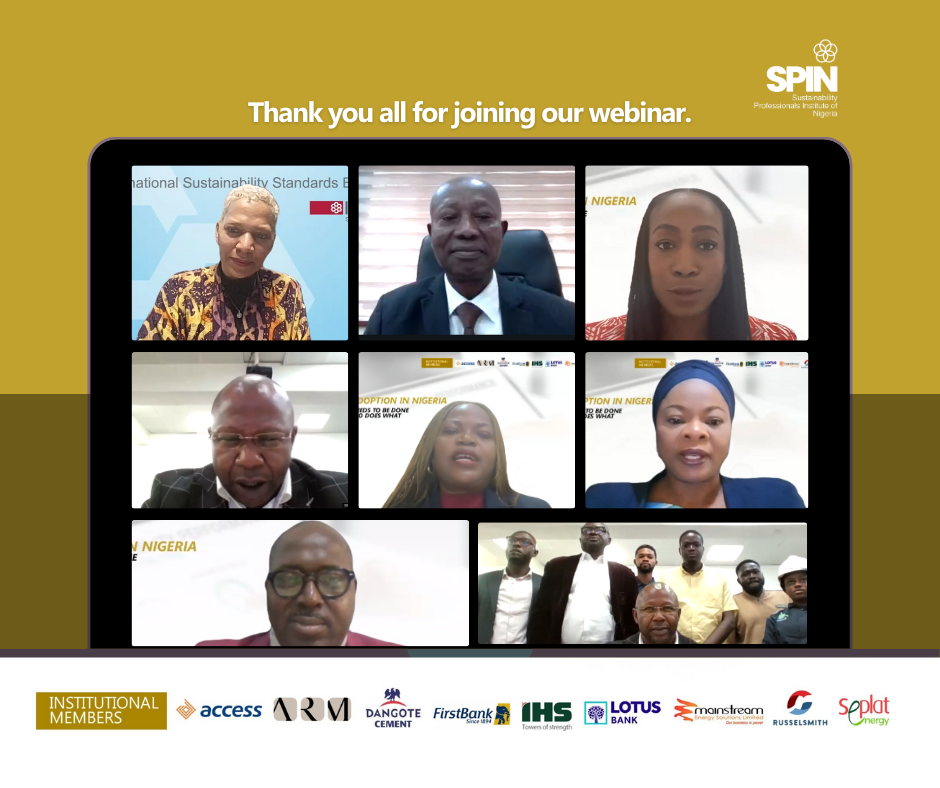
To support this transition and clarify roles for successful execution, SPIN convened a knowledge exchange titled, ISSB Adoption in Nigeria: What Needs to Be Done and Who Does What. Held virtually on Thursday, January 29, 2026, the webinar brought together more than 450 regulators, sustainability practitioners, financial report preparers, assurance providers and board members to align on the roadmap, demystify the standards and strengthen collaboration.
The session reinforced a core message: high-quality sustainability reporting is not a peripheral compliance exercise. It is a strategic lever for lowering the cost of capital, attracting long-term finance and strengthening competitiveness in a global economy that rewards credible disclosure. Nigeria’s early mover advantage must now translate into disciplined, coordinated execution.
Key Strategic Insights
Nigeria’s early adoption is strategic, not symbolic, and strengthens access to global capital markets. IFRS S1 and S2 are financial reporting standards designed to deliver decision-useful information on sustainability-related risks and opportunities that affect enterprise value. They require integration with governance, strategy, risk management and metrics, aligned with financial statements.
Successful implementation demands cross-functional collaboration among regulators, accountants, sustainability professionals, assurance providers and boards. Clear responsibilities are essential: regulators must provide stewardship and enforce discipline; preparers must integrate sustainability data into reporting cycles; sustainability professionals must strengthen technical competence and controls; boards must own sustainability risks and disclosures; and assurance providers must build capacity for credible assurance.
The ISSB provides a global baseline but Nigeria must avoid “false simplicity.” An “ISSB Plus” approach, including interoperability with frameworks such as GRI, is needed to reflect local realities. Capacity building is critical as Nigeria moves from voluntary adoption (2023-2027) toward mandatory reporting by 2028. Robust data systems, internal controls and assurance readiness are now non-negotiable.
SPIN urges stakeholders to move from awareness to action by finalizing clear timelines, investing in systems and skills, integrating ISSB requirements into governance and enterprise risk management, and engaging with available training, consultations and guidance.
We would like to thank all speakers, moderators and participants for their expertise and commitment. Special recognition to Dr. Eunice Sampson, Dr. Mories Atoki (Hon.), Dr. Akinkunle Akiode, Dr. Ndidi Nnoli-Edozien, Dr. Rabiu Olowo, Dr. Haruna Yahaya, Dr. Bekeme Masade-Olowola, Dr. Abubakar Razak and Dr. Eustace Onuegbu.